

How To Cook Texas Brisket On A Charcoal Grill
Cooking brisket at home doesn’t have to mean buying a giant smoker. In this guide, Barrett Black walks through the snake method, a simple charcoal grill setup that delivers steady heat, great smoke flavor, and a beautiful brisket bark.
Watch the Video
.svg)

If you think you need a giant offset smoker and an overnight cook to make great brisket, good news, you don’t.
At Black’s Barbecue, we’ve learned that cooking brisket isn’t about fancy equipment. It’s about understanding how fire, smoke, and time coordinate to cook the meat. And the truth is, you can cook an incredible smoked brisket on a basic charcoal grill using a simple setup called the snake method. Pitmaster Barrett Black shows you how.
Let’s walk through exactly how to do it.
The Charcoal Snake Method Setup
The snake method involves using charcoal and letting it burn slowly by arranging it in a slow-burning line that gradually ignites over several hours. Instead of burning all the charcoal in a chimney starter, you only burn a little part and let the fire crawl along the “snake.”
This gives you long, controlled heat without constantly adding fuel.
What you’ll need
- A basic charcoal grill (like a Weber charcoal kettle)
- Charcoal briquettes
- Wood chips (post oak, hickory, or similar)
- Aluminum foil
- A disposable water pan
- A brisket (half brisket works best for grill size)
Briquettes are recommended because they’re uniform in size. That consistency makes your burn time much more predictable compared to lump charcoal.
Step 1: Build the Charcoal Snake
Start by stacking charcoal briquettes along the edge of the grill in a curved line.
Barrett's preferred setup looks like this:
- One layer of charcoal briquettes leaned along the edge
- Three charcoal briquettes stacked flat on top
- Form a semicircle along the grill wall
This density helps maintain the ideal brisket temperature range of 250–275°F.
You don’t want the ends of the snake touching. If both ends ignite at once, the fire will burn through your fuel too quickly.
When finished, the snake should be able to burn for 6 to 7 hours slowly around the grill.
Step 2: Make Wood Chip Smoke Packets
Charcoal provides heat, but wood provides flavor.
Instead of throwing loose wood chips directly onto the coals, Barrett recommends making foil packets. This helps control the smoke and prevents the chips from igniting too quickly.
How to make the packets
- Place a large handful of wood chips in foil.
- Fold it over once.
- Fold the sides in.
- Roll it tight like a burrito.
Then poke about five small holes in the foil.
- One hole in each corner
- One hole in the middle
This lets smoke escape while limiting oxygen, so the chips smolder instead of burning.
You’ll want about 7 packets spaced along the snake so smoke is produced throughout the cook.
Step 3: Add a Water Pan
Start with a disposable aluminum pan. Fill it with water and place inside the grill.
It doesn’t catch all the drippings. Its real purpose is to add a bit of humidity inside the grill, which helps the brisket stay moist during the long cook.
Step 4: Light the Start of the Snake
Light a small handful of charcoal in a chimney starter.
You don’t need them fully ashed over. Just get them partially lit.
Then carefully pour them at the beginning of the snake, making sure the lit coals are touching the first briquettes in the line. That starts the slow chain reaction.
Once lit, the snake will slowly burn along the charcoal line for hours.
Step 5: Place the Brisket on the Grill
Keep the seasoning simple.
Our Texas beef brisket is seasoned with just salt and pepper, because let the smoke do most of the work. Once seasoned, place the brisket on the opposite side of the grill from the lit coals.
A key trick from Barrett Black:
- Point the thickest part of the brisket toward the heat source
- Keep the brisket as far from the burning coals as possible
This helps prevent burning while still cooking evenly.
Step 6: Manage Heat and Airflow
Airflow is a critical component when cooking with a kettle grill.
In Barrett’s method, you open both the top and bottom vents fully. After that, you place the lid so that its top is directly above the brisket. This draws heat and smoke over the brisket before it leaves the grill.
In using the snake method, you can achieve a temperature of 250-275°F.
Step 7: Rotate the Brisket Every Hour
Set a timer for one hour.
Each hour:
- Check where the lit charcoal has moved.
- Rotate the brisket so it stays farthest away from the burning coals.
Rotating the brisket keeps the heat even and helps to prevent hot spots on the bottom of the brisket.
Continue rotating until the brisket becomes probe tender.
The Result: Real Barbecue Bark
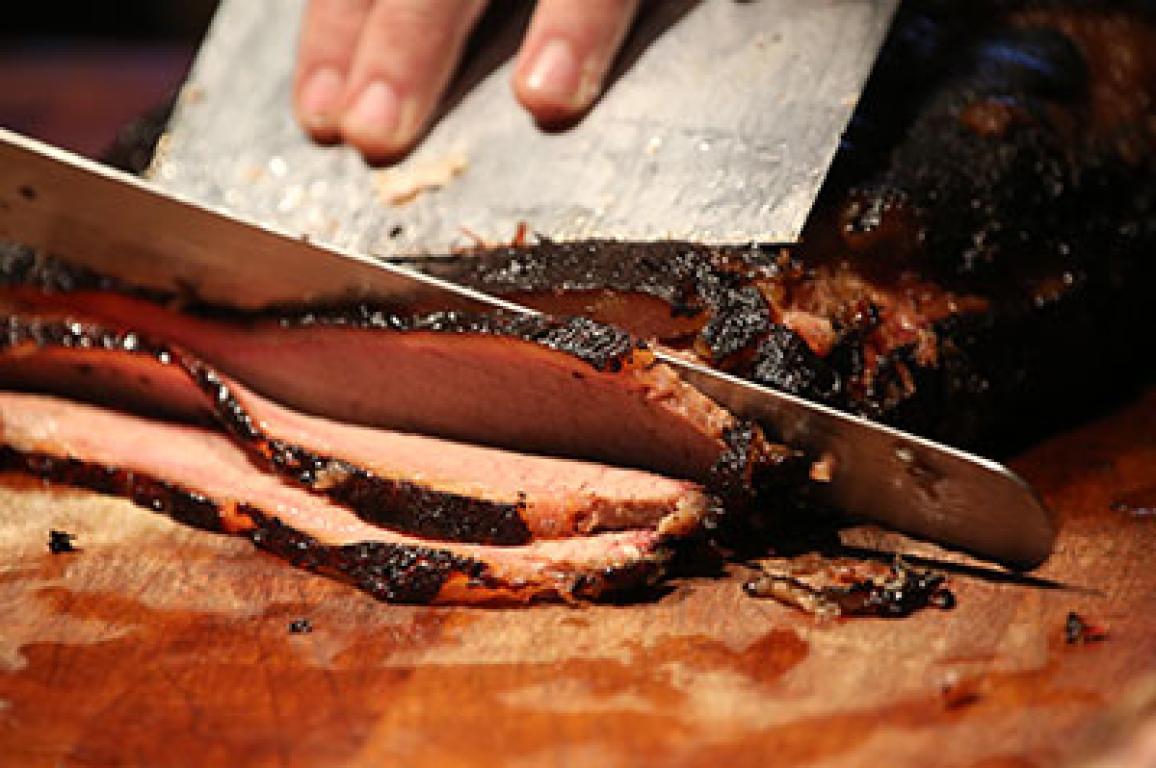
When it’s done right, you’ll get everything you expect from true Texas brisket:
- Dark bark
- Rendered fat
- A visible smoke ring
- Tender slices that pull apart easily
And it’s all possible without a massive smoker.
As Barrett Black likes to say, it’s not the smoker, it’s the pitmaster.
Quick Recap
- Build a charcoal snake around the grill edge
- Add wood chip foil packets along the snake
- Place a water pan inside the grill
- Light one end of the charcoal line
- Put the brisket opposite the fire
- Keep vents open for airflow
- Rotate the brisket every hour
Follow that process, and your charcoal grill can produce Texas BBQ brisket that rivals much larger setups.